
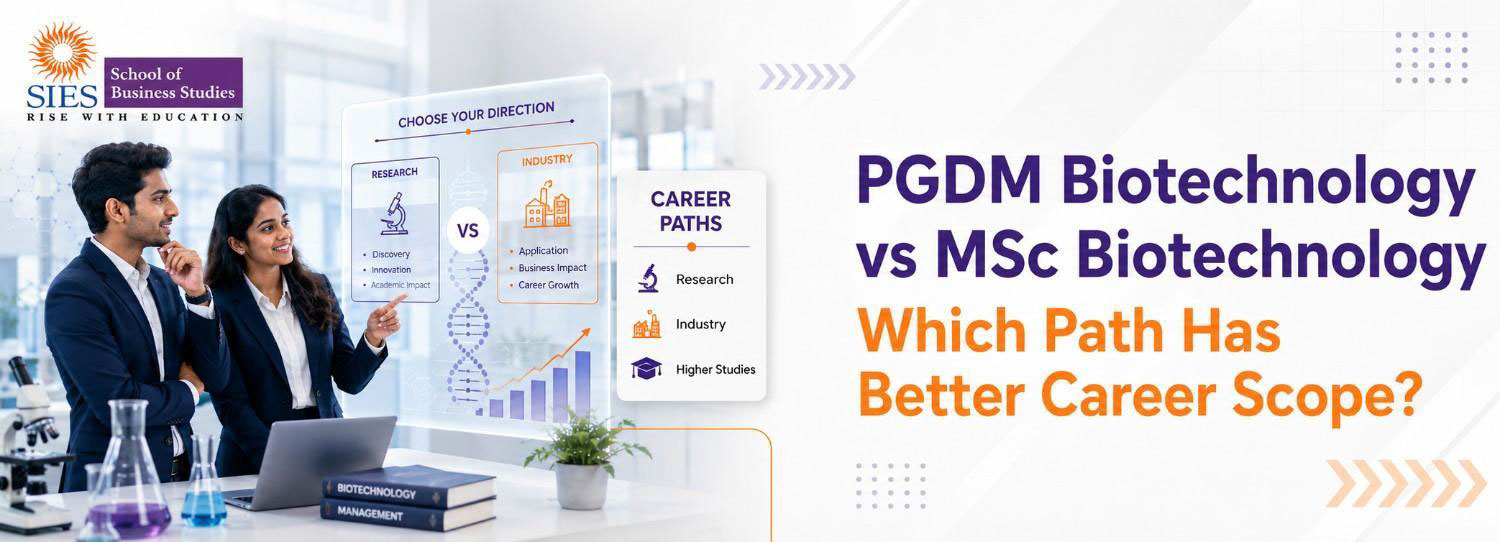
A student completes BSc Biotechnology. The family is proud, but the next question comes quickly: "Should we choose MSc or management?" One person says MSc is safer because it is a science degree. Another says a post graduate diploma in management may give better industry exposure. The student is confused because both choices sound sensible.
PGDM Biotechnology and MSc Biotechnology are postgraduate options after biotechnology or life science. MSc focuses on research and lab work. PGDM Biotechnology connects biotechnology with management, business, and industry roles.
This question matters now because biotechnology is growing beyond labs. According to the India Brand Equity Foundation, India’s bioeconomy reached US$195.3 billion by 2025, and registered biotech startups grew from 10,075 in 2024 to 11,855 in 2025. That means the industry needs research talent, but it also needs people who can manage biotech products, markets, regulations, customers, and business decisions.
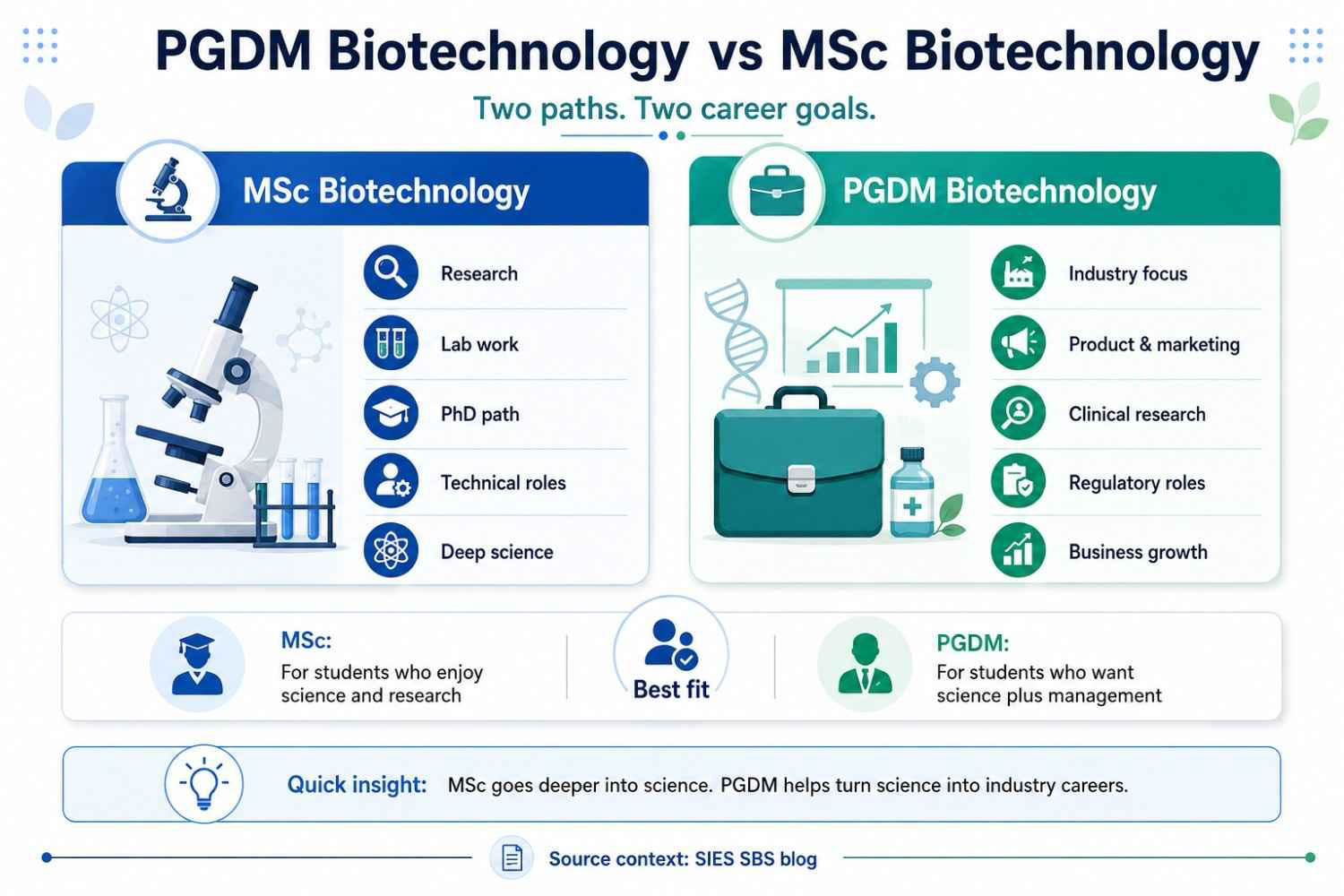
Choose MSc Biotechnology if you want research, lab work, PhD, teaching, diagnostics, or technical science roles.
Choose PGDM Biotechnology if you want pharma, biotech business, clinical research, regulatory affairs, product management, marketing, healthcare management, consulting, or startup roles.
The common mistake is thinking both courses lead to the same future. They do not. MSc takes you deeper into science. A pg diploma in management with a biotechnology focus helps you take science into the industry.
MSc Biotechnology is usually a 2-year postgraduate science degree. It focuses on subjects such as molecular biology, genetics, microbiology, immunology, cell biology, bioprocessing, and bioinformatics.
It is a good fit for students who enjoy:
MSc Biotechnology can be a strong route for students who want to build deep scientific knowledge. But students should also understand one practical point. For independent research and senior R&D roles, higher study often becomes important. The U.S. Bureau of Labor Statistics says a PhD is usually needed for independent research roles in biochemistry and biophysics, while bachelor’s and master’s degree holders can enter some early roles.
So, MSc is a good path, but for many serious research careers, it may be the beginning of a longer journey.
PGDM Biotechnology is a management-focused program for students who like biotechnology but do not want to limit themselves to lab roles. It prepares students for the business side of biotechnology, where science meets markets, regulations, finance, strategy, and people.
At SIES SBS, the PGDM in Biotechnology is a 2-year full-time AICTE-approved program. It combines management and biotechnology disciplines and is built for the niche needs of the biotech and allied healthcare sectors.
This is where the program becomes different from a general diploma in biotechnology. It is not only about learning science. The curriculum includes a 60:40 mix of management and biotech subjects, with areas like Intellectual Property Rights, Biotech Business Environment, Clinical Research, FDA, International Business, and Strategic Marketing.
That is also why students searching for management diploma courses, PGDM in biotechnology, or PGDM colleges in Mumbai should look beyond the course title. They should check whether the program actually connects biotechnology with industry needs.
If you want a biotech career beyond the lab, explore the PGDM in Biotechnology program.
| Point | MSc Biotechnology | PGDM Biotechnology |
|---|---|---|
| Course focus | Science and research | Biotechnology with management |
| Best for | Lab, PhD, teaching, technical roles | Pharma, biotech business, clinical research, regulatory roles |
| Learning style | Theory, lab work, dissertation | Management subjects, biotech applications, projects |
| Career direction | Research and academic side | Corporate and industry side |
| Student fit | Loves experiments and research | Likes science plus business |
| Growth path | Stronger with PhD or specialisation | Stronger with industry exposure and performance |
What most people do not realise is that a biotech company does not run only on scientists. It also needs managers who understand biotech products, approvals, pricing, marketing, customers, and teams.
This is why PGDM Biotechnology can be a practical choice for students who want to stay connected to science but work in the industry side.
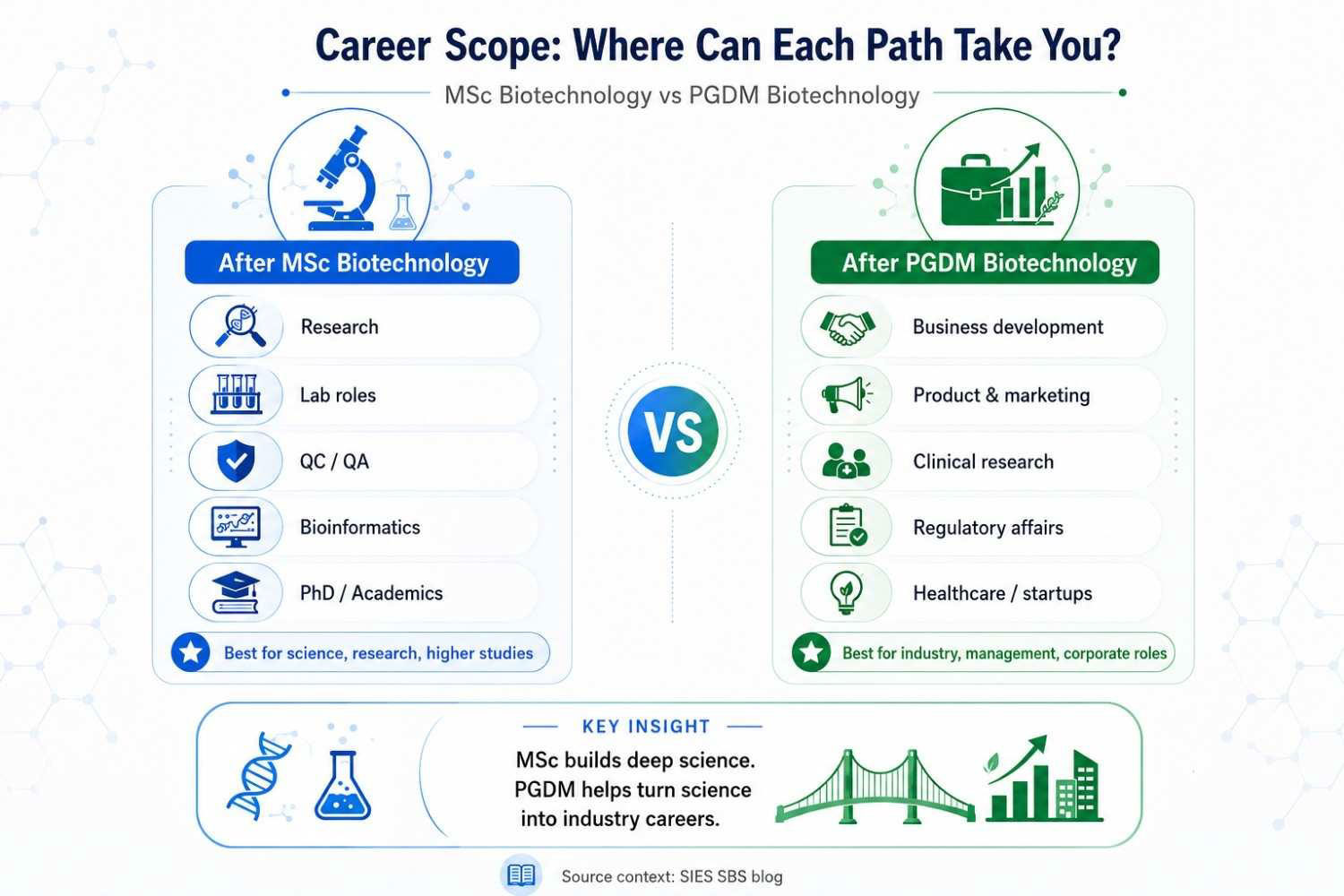
After MSc Biotechnology, students can explore roles such as:
This path suits students who enjoy detailed technical work. If you like experiments, lab instruments, journals, samples, and research questions, MSc can be a good choice.
But students and parents should keep expectations clear. Some MSc roles may start at junior level. Growth becomes stronger when students add PhD, GATE, CSIR NET, DBT-JRF, research papers, bioinformatics, data skills, or specialised lab training.
PGDM Biotechnology can lead to roles such as:
This path is suitable for students who enjoy science but also like communication, planning, people, brands, and business problems.
At SIES SBS, the PGDM Biotechnology program includes corporate integration through teaching, concurrent projects, guest lectures by industry professionals, and industrial visits. It also includes leadership development, personality development, research activity, and an optional foreign language subject, Business German. These small details matter because students do not grow only by reading theory. They also need exposure, confidence, and decision-making ability.
The World Economic Forum Future of Jobs Report 2025 says technology change, demographic shifts, and the green transition will reshape jobs by 2030. Biotechnology is also moving in that direction. Pharma, diagnostics, vaccines, bio-services, clinical research, healthcare, and allied sectors need people who can understand both science and management.
Students comparing broader PGDM options can also read about the post graduate diploma in management.
The course name is not enough
Many students select a course because it sounds popular. That is risky. First check the role you want after the course. If you want research, MSc makes sense. If you want biotech industry roles, PGDM Biotechnology may be a better fit.
Lab skill and market skill are different
A biotech product does not reach people only because the science is good. It needs testing, approval, finance, pricing, marketing, sales, storage, distribution, and customer education.
MSc students usually enter the science-heavy side. PGDM Biotechnology students often enter the market-facing side.
Salary depends on role, not only degree
Parents often ask, "Which course gives better salary?" The honest answer is: it depends. MSc can give strong growth with PhD and specialisation. PGDM Biotechnology may give faster exposure to corporate roles, especially in pharma, biotech, clinical research, healthcare, and product teams.
Mumbai can be an advantage
For students searching for the best PGDM colleges in Mumbai or best colleges in Mumbai for PGDM, location can matter. Mumbai and nearby areas give access to pharma companies, hospitals, diagnostics firms, corporate offices, healthcare networks, and industry events. So, while checking pgdm colleges in Mumbai, students should look at curriculum, industry exposure, projects, placement support, and how closely the course matches their career goal.
Choose MSc Biotechnology if:
Choose PGDM Biotechnology if:
A post graduate diploma in management with biotechnology focus can be a smart choice for students who want to use their science background in business roles without moving completely away from biotechnology.
If you are exploring the best PGDM colleges in Mumbai for a biotech-focused career, visit the SIES SBS website and compare the program with your career goal.
PGDM Biotechnology and MSc Biotechnology both have career scope. The better option depends on the future you want.
MSc Biotechnology suits students who want research, lab work, PhD, teaching, diagnostics, or technical science roles. PGDM Biotechnology suits students who want pharma, biotech business, clinical research, regulatory affairs, product management, marketing, healthcare, or startup roles.
If your goal is to go deeper into science, MSc is a good path. If your goal is to take biotechnology into the world of companies, products, regulations, and markets, a post graduate diploma in management with a biotech focus may give you a more practical direction.
So, before choosing, ask yourself one clear question: do I want to build my career inside the lab, or do I want to help take biotech ideas from the lab to the market?