
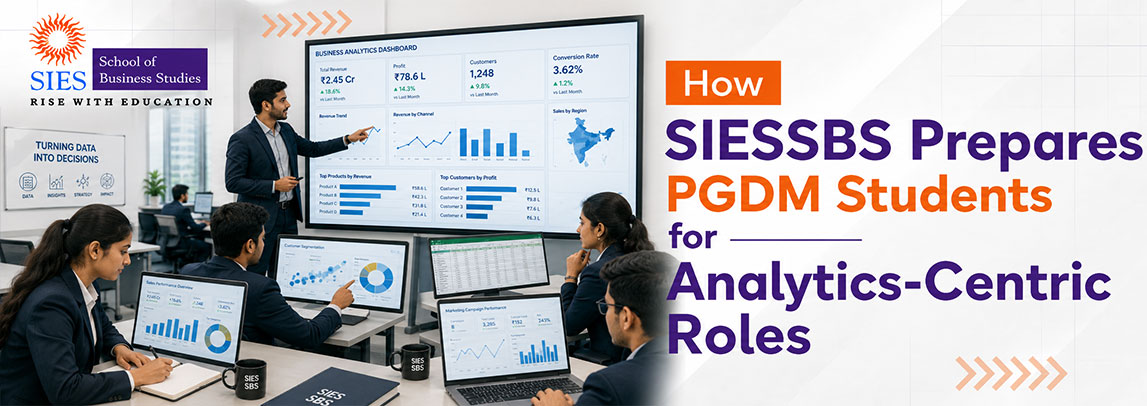
On a normal evening, a student scrolls through job posts after graduation. One role says "business analyst.” Another says "marketing analyst.” A third asks for Excel, Power BI, data interpretation, and decision-making skills. The student understands the words, but one doubt stays in mind: "I am from a management background. Can I really prepare for these roles?”
Many parents also have the same concern. They want a course that gives management knowledge, but they also want career relevance. Today, companies do not want managers who only speak well. They want young professionals who can read data, ask the right questions, and suggest practical decisions.
Analytics-centric roles are jobs where professionals use data, business thinking, and simple tools to support better decisions in marketing, finance, HR, operations, logistics, consulting, pharma, and biotech.
The workplace is changing fast. According to the World Economic Forum Future of Jobs Report 2025, analytical thinking is the most sought-after core skill, with seven out of ten companies considering it essential in 2025. The same report says AI and big data are among the fastest-growing skills for 2025 to 2030.
This matters for students who are planning a post graduate diploma in management. Management roles are becoming more data-led. Marketing teams study campaign results. Finance teams study risk. HR teams use hiring and retention data. Operations teams track delays, cost, and process gaps.
IBM’s India AI adoption report says 59% of large Indian enterprises surveyed had actively deployed AI, while another 27% were exploring it. That means students are not preparing for a distant future. They are preparing for the workplace that already exists.
Many articles talk only about tools. Excel, Power BI, Tableau, Python, and AI are useful. But analytics does not begin with a tool. It begins with a business question.
| Business Question | How Analytics Helps |
|---|---|
| Why did sales drop this month? | Checks region, pricing, season, customer, and competitor data |
| Which product needs more budget? | Compares demand, cost, margin, and conversion |
| Why are deliveries delayed? | Tracks vendor, inventory, location, and process patterns |
| Which customer group is more likely to buy? | Studies behavior, need, income, and past response |
This is the part most websites miss. A student does not become job-ready only by learning a dashboard. A student becomes more ready when they understand what the data means for the business.
A good pg diploma in management should help students connect theory with real business decisions. The PGDM program is AICTE-approved and is designed as a 24-month full-time program over six trimesters. The official program page also mentions knowledge-building projects, leadership, communication, interpersonal skills, and corporate integration through seminars, workshops, guest lectures, visiting faculty, and concurrent projects.
This matters because analytics-centric roles need three skills together.
| Skill | Why It Matters |
| Business Understanding | Students know the market, customer, cost, and process |
| Data Interpretation | Students read patterns, gaps, and trends |
| Communication | Students explain insights in simple business language |
A student may create a report. But if the student cannot explain what the report means, the report has limited value. Analytics roles need both thinking and communication.
Want to understand the academic structure better? Visit the PGDM program page and check how the course supports management learning.
The official PGDM program outcome includes analytical and critical thinking ability for data-based decision-making. It also mentions the use of modern technology for business applications, research, and communication.
This is important for students and families because companies do not only need people who collect numbers. They need people who can understand what those numbers are saying.
For example, a sales drop may look simple at first. But the reason could be pricing, seasonality, low awareness, weak location reach, poor follow-up, or strong competition. Analytics helps students check assumptions before giving advice.
Analytics is not only for IT companies. It is now part of daily work in many business areas.
| Career Area | How Analytics Helps |
|---|---|
| Marketing | Studies customer behavior and campaign performance |
| Finance | Tracks cost, revenue, risk, and investment signals |
| HR | Improves hiring, training, and retention decisions |
| Operations | Reduces delay, waste, and process gaps |
| Logistics | Tracks inventory, delivery, vendor, and cost patterns |
| Pharma | Studies market demand, product performance, and sales trends |
| Biotech | Connects science, market, research, and business data |
This is also useful for students from science backgrounds. A student searching for a diploma in biotechnology may want technical learning. But a student who wants business-facing roles in biotech can also explore PGDM in Biotechnology, because it connects management and biotechnology disciplines. The official program page mentions management subjects and biotech subjects, along with areas such as IPR, clinical research, FDA, international business, and strategic marketing.
Analytics cannot be learned only from notes. Real business problems are messy. Customer behavior changes. Market answers are not always clear. Data may show one thing, but ground reality may show another.
This is why projects, internships, case studies, corporate interaction, and live exposure matter. The PGDM page mentions knowledge-building projects in each semester and corporate integration through seminars, workshops, guest lectures, visiting faculty, and concurrent projects.
Here is the surprising truth about projects: they teach students how to handle incomplete information. In the real world, no manager gets perfect data every time. Students must learn to ask better questions, compare options, and explain a practical recommendation.
For institute details, legacy, and academic background, visit the About Us page before shortlisting a management program.
Data can help, but blind trust in data can create mistakes. IBM’s India report says limited AI skills, ethical concerns, and data complexity are barriers to AI adoption. It also says 94% of surveyed IT professionals in companies exploring or deploying AI felt that explaining how AI reached a decision is important for business.
This is a major learning point for future managers. Students should not only ask, "What does the data show?” They should also ask:
This is where critical thinking becomes a career skill. A manager must know when to trust data, when to question it, and when to add human judgment.
Analytics is no longer a separate skill for only technical teams. It is becoming part of everyday management work. A student who can understand data, ask the right questions, and explain insights clearly can become more prepared for modern business roles.
The role of SIESSBS is relevant here because its management education focuses on business learning, analytical thinking, technology use, projects, and corporate exposure. Students can also visit the official website to explore programs, updates, and admission-related information.
So, when you compare courses, ask one simple question: will this program help you think, decide, and communicate in a data-driven business world?